How to Use the Tile Grout Calculator
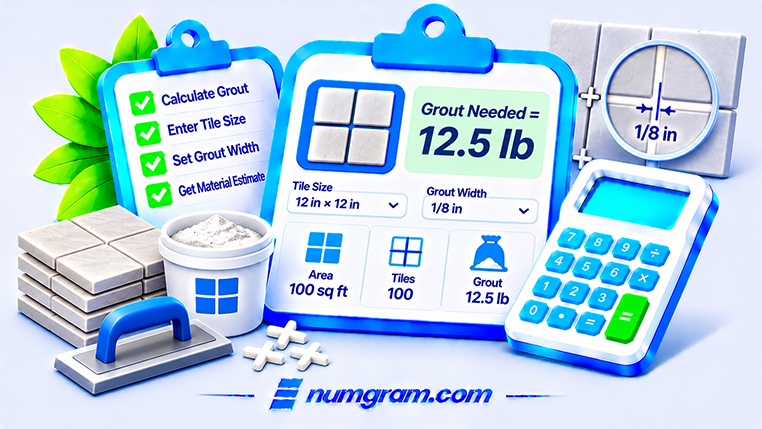
Use this tile grout calculator to estimate the grout needed for a tiled floor, wall or backsplash. Enter the total tiled area, the tile’s face width and height, the grout joint width, the planned grout depth, and the grout product’s approximate density. Add an optional waste allowance for mixing losses and small variations in joint dimensions. The calculator estimates grout volume and weight in cubic feet, pounds and kilograms.
The estimate uses a repeating tile-and-joint pattern. It assumes a regular grid of rectangular tiles with consistent joint width and depth. It is useful for preliminary material planning, but actual grout consumption depends on tile edge shape, spacing, surface texture, installation technique and the product formulation. For the most accurate quantity, use the grout manufacturer’s coverage chart or calculator for the exact product and tile dimensions.
Measurements and Product Information
Tiled Area
Measure the total surface area that will be grouted. You can combine separate rectangular sections, such as a floor and a backsplash, if they use the same tile and grout joint. Do not include areas that will not receive grout. For complex layouts, calculate each area separately and add the estimates.
Tile Width and Height
Enter the actual face dimensions of one tile. For square tile, width and height are the same. For rectangular tile, enter each dimension separately. Use the dimensions of the individual tile rather than the sheet size for mosaics unless the sheet layout and grout pattern make the sheet dimensions appropriate for your estimate. Tile spacers and edge profiles can affect the effective joint pattern.
Grout Joint Width
Enter the planned width of the grout joint. A wider joint generally requires more grout. Follow the tile manufacturer’s instructions and the grout product’s recommended joint range. The suitable width depends on tile size variation, edge type, layout and installation conditions. This calculator does not decide what joint width is appropriate for a tile installation.
Grout Depth
Enter the approximate depth of the grout joint to be filled. Grout depth is not always identical to tile thickness: the joint may be partly occupied by mortar or another setting material. Follow the grout manufacturer’s instructions for minimum and maximum joint depth, and use the actual depth that will be filled with grout.
Grout Density
Enter the grout’s approximate bulk density in pounds per cubic foot. The default value is a planning assumption, not a specification for every grout product. Density varies by formulation and whether a product is measured dry, mixed or cured. If the manufacturer provides a yield or coverage chart, use that product-specific information instead of relying on a generic density estimate.
Waste Allowance
An optional allowance can account for mixing residue, spillage, uneven joints, tile texture and small measurement differences. Choose a modest percentage based on the job. A waste allowance does not replace checking the grout packaging and manufacturer coverage information.
Tile Grout Calculator Formula
The calculator estimates the grout fraction within one repeating tile module. The module consists of the tile face plus the joint width in each direction.
- Tile module width: tile width + grout joint width.
- Tile module height: tile height + grout joint width.
- Grout area fraction: 1 − (tile width × tile height) ÷ (module width × module height).
- Grout volume: tiled area × grout depth × grout area fraction.
- Volume with waste: grout volume × (1 + waste percentage ÷ 100).
- Grout weight in pounds: volume in cubic feet × grout density in lb/ft³.
- Grout weight in kilograms: pounds × 0.45359237.
This simplified grid model treats grout joints as a continuous network between rectangular tiles. It is an approximation; actual joint volume may differ at borders, movement joints, irregular tile edges, textured surfaces and around cut pieces. The estimate also assumes the entered density is representative of the grout quantity basis being used.
Worked Example: 100 Square Feet of Tile
Suppose you are grouting 100 square feet of tile. Each tile is 12 inches by 12 inches, the grout joint is 1/8 inch wide, and the filled grout depth is 1/4 inch. Use an assumed grout density of 100 pounds per cubic foot and add 10% for waste.
| Step | Calculation | Estimate |
|---|---|---|
| Tile module | 12.125 in × 12.125 in | 147.02 sq in |
| Tile face area | 12 in × 12 in | 144 sq in |
| Grout area fraction | 1 − 144 ÷ 147.02 | 2.05% |
| Grout volume before waste | 100 sq ft × 1/4 in × 2.05% | 0.043 cu ft (approx.) |
| Volume with 10% waste | Volume × 1.10 | 0.047 cu ft (approx.) |
| Grout weight | Volume × 100 lb/cu ft | 4.7 lb (approx.) |
| Weight in kilograms | 4.7 × 0.453592 | 2.1 kg (approx.) |
This example is a geometric estimate, not a product coverage guarantee. The exact product may require a different quantity. Compare the estimate with the manufacturer’s coverage chart and buy an appropriate package size, allowing for the actual tile profile and joint depth.
Tips for Estimating Grout Accurately
- Measure the actual tile face dimensions and joint width rather than relying on nominal sizes.
- Use the filled joint depth, not automatically the full tile thickness.
- Check the grout manufacturer’s coverage chart for your exact product and joint dimensions.
- Textured or absorbent tile faces can make cleanup harder and may affect practical grout use.
- Mosaics and small-format tiles usually have more joint length per unit area than large-format tiles.
- Irregular, tumbled or hand-made tile can have variable joint widths and greater grout consumption.
- Use the correct grout type for the joint width, tile material and exposure conditions.
- Follow product instructions for mixing, working time, application, cleaning and curing.
Assumptions and Limitations
This calculator uses a regular rectangular grid and estimates grout volume from tile face area, joint width and filled depth. It does not model irregular tile edges, variable joint widths, mosaics on sheets, diagonal layouts, movement joints, perimeter joints, deep voids, tile texture or installation losses in detail. The density input is an approximation and may not match the yield of a specific dry grout product after mixing. Manufacturer coverage charts and package instructions take precedence. This calculator is for planning only and does not specify grout type, suitability, waterproofing or installation method.
Frequently Asked Questions
How Much Grout Do I Need per Square Foot?
It depends on tile size, joint width, joint depth and grout formulation. Smaller tiles and wider or deeper joints generally use more grout per square foot. Enter your dimensions or consult the exact product’s coverage chart.
Does Tile Size Affect Grout Quantity?
Yes. Smaller tiles create more joint length across the same area, which usually increases grout consumption. The tile dimensions are included in the repeating-module calculation.
Should I Use the Full Tile Thickness for Grout Depth?
Not necessarily. The actual grout depth can be less than tile thickness if setting material occupies part of the joint. Follow the product instructions and use the depth that will actually be filled.
What Grout Density Should I Enter?
Use a product-specific value if the manufacturer provides one. Otherwise, treat the default as a rough planning assumption and verify the result against the manufacturer’s coverage chart or package yield.
Does This Calculate Grout for Shower Tile?
It can provide a preliminary estimate for a tiled shower surface if you enter the tiled area and joint dimensions. It does not determine grout suitability for wet areas or replace waterproofing requirements. Choose a grout system approved for the application.
Can I Enter Metric Measurements?
Yes. Use the unit selectors for tiled area, tile dimensions, grout width and depth. The calculator converts compatible measurements before estimating grout volume and weight.
Why Is the Manufacturer's Coverage Chart Different?
Manufacturers may use product-specific density, tile profiles, joint geometry and installation assumptions. Their chart is usually more suitable for ordering that particular grout than a generic geometric estimate.
How Much Extra Grout Should I Buy?
Use an allowance that reflects tile shape, surface texture, joint variation and mixing losses. Check package sizes and the manufacturer’s recommendation before purchasing.
Editorial note: Use this result as an initial estimate only. Product-specific grout coverage and installation instructions should guide the final purchase.