How to Use the Concrete Slab Calculator
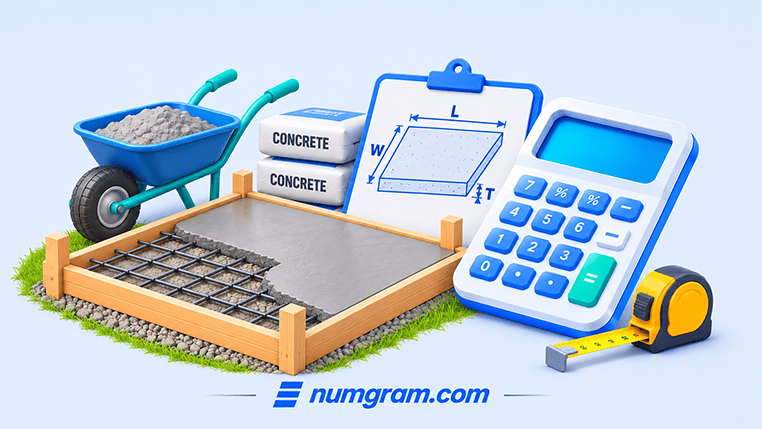
Use this concrete slab calculator to estimate the amount of ready-mix concrete needed for one or more rectangular slabs. Enter the slab length, width and thickness, the number of identical slabs, and an allowance for waste or uneven subgrade. The calculator estimates concrete volume in cubic feet, cubic yards and cubic metres.
Measure the dimensions of the concrete section itself. Thickness is especially important: a small change in slab depth can noticeably change the required volume. If the project includes separate pads, steps, thickened edges, footings or irregular shapes, calculate those sections separately and add their volumes. This tool is a quantity estimator, not a structural design or reinforcement specification.
Measurements to Collect
Slab Length and Width
Measure the planned concrete footprint. For a rectangular slab, length multiplied by width gives the plan area. For multiple identical slabs, enter the number of slabs separately. For an L-shaped or irregular footprint, divide the project into rectangles, calculate each section, and add the results. Avoid double-counting overlapping areas.
Concrete Thickness
Enter the intended slab thickness, measured vertically from the prepared base to the finished concrete surface. Use a consistent thickness for the whole slab. If the design has thickened edges, a sloped surface or varying depth, a single average thickness may not be accurate; calculate the additional concrete separately using the actual design.
Number of Slabs
Enter how many slabs share the same dimensions and thickness. For example, if you are pouring three identical equipment pads, enter three. If the slabs have different sizes, estimate each one separately and add the volumes.
Waste and Overage Allowance
The extra percentage provides a planning allowance for minor measurement variation, small losses and unevenness. It is not a substitute for proper excavation, formwork, base preparation or a measured takeoff. The suitable allowance depends on site conditions and supplier ordering increments. Ask the concrete supplier or contractor what overage is appropriate for the project.
Concrete Slab Calculator Formulas
The calculator converts all length inputs to metres internally, multiplies the dimensions, and then converts the resulting volume into the selected output units.
- Volume of one slab: length × width × thickness.
- Total base volume: length × width × thickness × number of slabs.
- Volume with allowance: total base volume × (1 + waste percentage ÷ 100).
- Cubic feet: cubic metres × 35.3146667.
- Cubic yards: cubic metres ÷ 0.764554858.
- Cubic metres: the calculated base volume in m³.
Because volume is length multiplied by width and thickness, all three dimensions must use compatible units. The calculator’s unit selectors allow customary or metric measurements to be entered independently. It normalizes the dimensions before multiplying, avoiding manual conversion between feet, inches, metres and centimetres.
Worked Example: a 20 Ft by 10 Ft Slab
Suppose you are pouring one rectangular slab that is 20 feet long, 10 feet wide and 4 inches thick. You want to include a 10% allowance for ordering.
| Step | Calculation | Estimate |
|---|---|---|
| Convert thickness | 4 ÷ 12 | 0.3333 ft |
| Slab footprint | 20 × 10 | 200 sq ft |
| Base volume | 20 × 10 × 0.3333 | 66.67 cu ft |
| Base cubic yards | 66.67 ÷ 27 | 2.47 cu yd |
| Volume with 10% extra | 66.67 × 1.10 | 73.33 cu ft |
| Order volume | 73.33 ÷ 27 | 2.72 cu yd |
| Metric volume | 2.72 × 0.764554858 | 2.08 m³ (approx.) |
For this example, the estimated volume including the 10% allowance is about 2.72 cubic yards, or 2.08 cubic metres. Confirm the order quantity with the concrete supplier. Suppliers may have minimum order quantities, delivery constraints and recommended rounding practices.
Planning Tips Before Ordering Concrete
- Measure the formed dimensions, not just the approximate area on a sketch.
- Check slab thickness at several points and confirm the design before calculating volume.
- Account separately for thickened edges, grade beams, footings, steps and separate pads.
- Prepare and compact the base as specified; an uneven subgrade can change the amount of concrete required.
- Confirm the concrete mix, strength, exposure class, slump and reinforcement requirements with the project designer or supplier.
- Ask the supplier about truck capacity, minimum loads, short-load charges and ordering increments.
- Plan access, placement, finishing, joints and curing before the truck arrives.
- Do not use this quantity estimate as a substitute for structural plans, local codes or professional advice.
Assumptions and Limitations
This calculator assumes each slab is a rectangular prism with uniform thickness. It does not automatically include thickened edges, footings, beams, steps, ramps, columns, voids, slopes, reinforcement displacement or complex shapes. It estimates volume only; it does not select concrete mix design, strength, reinforcement, subbase depth, joint spacing or curing method. Actual site conditions and supplier ordering practices can affect the quantity delivered. Have structural and construction details confirmed by a qualified professional and check local requirements before pouring.
Frequently Asked Questions
How Much Concrete Do I Need for a 10 × 20 Slab?
The volume depends on slab thickness. At 4 inches thick, a 10 × 20 foot slab contains about 66.67 cubic feet, or 2.47 cubic yards, before any overage. Enter your actual thickness and allowance to estimate the order quantity.
How Many Cubic Feet Are in a Cubic Yard of Concrete?
One cubic yard equals 27 cubic feet. Divide cubic feet by 27 to convert to cubic yards, or multiply cubic yards by 27 to convert to cubic feet.
How Do I Convert Concrete Volume to Cubic Metres?
One cubic yard is approximately 0.7646 cubic metres. The calculator reports cubic metres directly alongside cubic feet and cubic yards.
Should I Include Extra Concrete?
A modest allowance can help account for measurement variation and site conditions, but the appropriate amount depends on the project. Ask the concrete supplier or contractor to confirm an appropriate order quantity.
Can I Calculate Several Slabs at Once?
Yes, if the slabs have identical length, width and thickness, enter their quantity. For different slab sizes or thicknesses, calculate each separately and add the volumes.
Does This Include Footings or Thickened Edges?
No. These elements have different dimensions and should be calculated separately from the uniform slab. Add their volumes to the slab estimate when preparing a complete concrete takeoff.
Can I Use Metres and Centimetres?
Yes. The length, width and thickness unit selectors work independently. You can enter dimensions in feet, inches, metres or centimetres and the calculator converts them to a common basis before calculating volume.
Does the Calculator Tell Me What Concrete Strength to Order?
No. Concrete strength and mix requirements depend on structural design, loads, exposure and local codes. Follow the project specifications and consult the responsible professional or concrete supplier.
Editorial note: This tool estimates concrete volume only. Confirm structural design, mix specifications, site preparation and order quantity before placing a concrete order.