How to Use the Food Cost Percentage Calculator
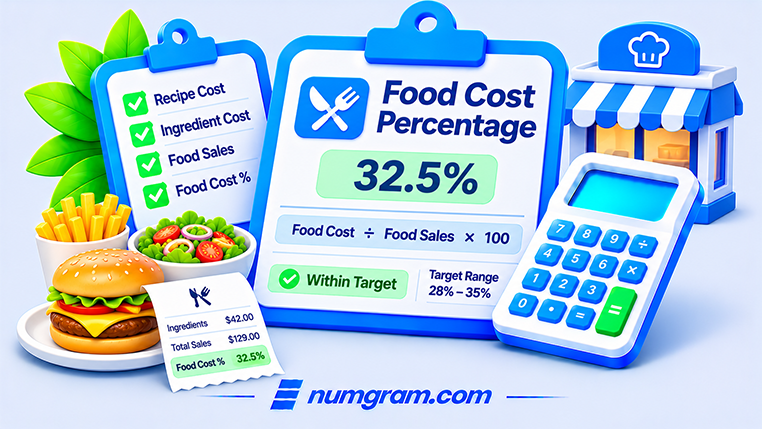
Use this food cost percentage calculator to measure ingredient cost as a share of food sales, estimate the cost of an individual serving, and work out a menu price based on a target food cost percentage. It can help restaurant owners, chefs, caterers, food trucks, and home-based food businesses review recipe costs and pricing assumptions.
Enter the total food cost and matching food sales for the same period to calculate food cost percentage. You can also enter the number of servings to estimate cost per serving. The target food cost percentage is used to calculate an indicative menu price from that per-serving cost. The calculator also estimates gross profit by subtracting food cost from food sales; this is not net profit.
Information to Enter
Total food cost is the ingredient or food inventory cost associated with the sales period or recipe being analyzed. For a period-based calculation, use a consistent inventory-cost method and include beginning inventory, purchases, and ending inventory as appropriate to your accounting process. For a recipe, total the ingredient quantities used in the batch.
Food sales is the revenue from the food items associated with that cost. Use food sales only when comparing food cost with food revenue. If your business also sells beverages, merchandise, or other items, keep those sales separate unless you intentionally want a combined measure.
Number of servings is the number of portions produced by the recipe or batch. It is used to divide total recipe cost into an estimated cost per serving. Enter a positive number of servings.
Target food cost percentage is the food-cost share of the menu price you want to plan around. For example, a 30% target means the ingredient cost should represent 30% of the selling price. The appropriate target depends on the restaurant concept, labor model, rent, other operating costs, and pricing strategy.
Food Cost Formulas
- Food cost percentage = total food cost ÷ food sales × 100
- Food cost per serving = recipe food cost ÷ number of servings
- Target menu price = food cost per serving ÷ (target food cost percentage ÷ 100)
- Estimated gross profit after food cost = food sales − total food cost
Food cost percentage is a cost ratio, not a profit margin. The gross profit estimate in this calculator subtracts only food cost from food sales. It does not subtract labor, rent, utilities, delivery commissions, marketing, taxes, or other operating expenses.
Worked Example
Suppose a restaurant records $300 in food cost and $1,200 in food sales for the same period. Food cost percentage is $300 ÷ $1,200 × 100 = 25%. If the $300 cost represents a recipe batch that makes 50 servings, cost per serving is $6. At a target food cost of 30%, the indicative menu price is $6 ÷ 0.30 = $20.
| Measure | Calculation | Result |
|---|---|---|
| Total food cost | Given | $300.00 |
| Food sales | Given | $1,200.00 |
| Food cost percentage | $300 ÷ $1,200 × 100 | 25.00% |
| Number of servings | Given | 50 |
| Food cost per serving | $300 ÷ 50 | $6.00 |
| Target food cost | Given | 30.00% |
| Target menu price | $6 ÷ 0.30 | $20.00 |
| Estimated gross profit after food cost | $1,200 − $300 | $900.00 |
Why Restaurants Monitor Food Cost Percentage
Food cost is one important part of restaurant operations. Monitoring it can reveal changes in ingredient prices, portion sizes, waste, purchasing practices, menu mix, and selling prices. A rising percentage may signal higher supplier costs, inconsistent portions, spoilage, theft, unrecorded waste, or menu prices that have not kept pace with costs.
Compare like with like. A period-based food cost percentage should use food cost and food sales from the same period and accounting basis. A recipe-level cost should use the ingredient quantities and yield for that recipe. Mixing a weekly cost with monthly sales, or recipe costs with unrelated sales, can produce a misleading ratio.
Actual Food Cost Versus Theoretical Food Cost
Actual food cost is commonly calculated from inventory movement and purchases over a period. Theoretical food cost estimates what ingredients should have cost based on recipes and the items sold. Comparing actual and theoretical food cost can help identify waste, portion variation, spoilage, incorrect recipes, recording errors, or inventory issues.
This calculator performs simple arithmetic on the figures you enter. It does not reconcile inventory, point-of-sale records, supplier invoices, recipe yields, or stock transfers. Use your accounting and inventory records for a complete actual-cost calculation.
Choosing a Target Food Cost
There is no single target percentage suitable for every restaurant. Ingredient mix, menu category, labor intensity, rent, service style, beverage sales, local competition, and customer expectations all affect the economics. A target that works for one concept may be unrealistic for another.
Use the target-price result as a starting point, then review local market prices, portion size, perceived value, competitor offerings, and the full operating cost structure. A menu price that meets a food-cost target may still be too low to cover labor and overhead, or too high for the market.
Ways to Manage Food Costs
Standardize recipes and portion sizes so each serving uses the intended quantities. Weigh ingredients where appropriate, train staff on preparation procedures, and review yields after trimming or cooking. Track spoilage and waste, rotate stock, and use purchasing forecasts to reduce over-ordering. Review supplier quotes and seasonal substitutions while maintaining food quality and safety.
Menu engineering can also help. Compare popularity and contribution dollars across menu items, not just food cost percentage. A dish with a higher food cost percentage may still generate more contribution dollars than a lower-cost item. Consider both guest demand and the amount left after ingredient cost.
Assumptions and Limitations
- The food cost percentage calculation assumes total food cost and food sales refer to the same period and scope.
- Cost per serving assumes the recipe cost and serving count describe the same batch.
- Target menu price is a simple food-cost-based estimate and does not include labor, overhead, taxes, delivery fees, or market positioning.
- Estimated gross profit subtracts only food cost from food sales; it is not operating profit or net profit.
- The calculator does not calculate inventory usage, waste, recipe yield, or theoretical food cost from point-of-sale data.
- Food sales must be greater than zero to calculate food cost percentage. Serving count and target percentage must also be greater than zero.
- Use the same currency and accounting basis for all monetary inputs.
Common Food Cost Mistakes to Avoid
Do not divide ingredient cost by total business revenue if the intention is to measure food cost against food sales only. Do not mix sales and cost figures from different periods. Include recipe yield and portion size when calculating per-serving cost, and update ingredient prices when suppliers change them. Remember that a target percentage alone does not prove a menu price is profitable after labor and overhead.
Review food cost trends over time and investigate meaningful changes rather than reacting to one unusual week. Use consistent inventory counts, purchasing records, and recipe standards so comparisons remain useful.
Frequently Asked Questions
What is food cost percentage?
Food cost percentage is food cost divided by food sales, multiplied by 100. It shows what share of food revenue is used to pay for the food or ingredients represented by the cost figure.
How do I calculate food cost percentage?
Divide food cost by food sales and multiply by 100. For example, $300 of food cost on $1,200 of food sales equals 25%.
What is a good food cost percentage?
There is no universal ideal. It varies with restaurant type, menu, location, labor model, and operating costs. Set a target based on your business economics and review it alongside contribution dollars and overall profitability.
How do I calculate menu price from food cost?
Divide food cost per serving by the target food cost percentage expressed as a decimal. A $6 serving cost at a 30% target gives a $20 indicative menu price.
Does food cost percentage include labor?
Usually, food cost percentage refers to food or ingredient costs relative to food sales. Labor is generally tracked separately, though businesses may also monitor combined prime cost.
Why did my food cost percentage increase?
Possible reasons include higher ingredient prices, waste, spoilage, portion changes, theft, sales mix shifts, discounts, or lower menu prices. Review inventory and sales records to identify the cause.
Is food cost percentage the same as gross profit margin?
No. Food cost percentage measures food cost as a share of food sales. Gross profit after food cost is the remaining sales amount, and its percentage is the complement only when the same cost and sales scope is used.
How often should I check food cost?
Many operators review key figures weekly or monthly, while recipe costs may be updated whenever ingredient prices or portions change. Choose a cadence that matches your purchasing and inventory cycle.