How to Use the Break-Even Calculator
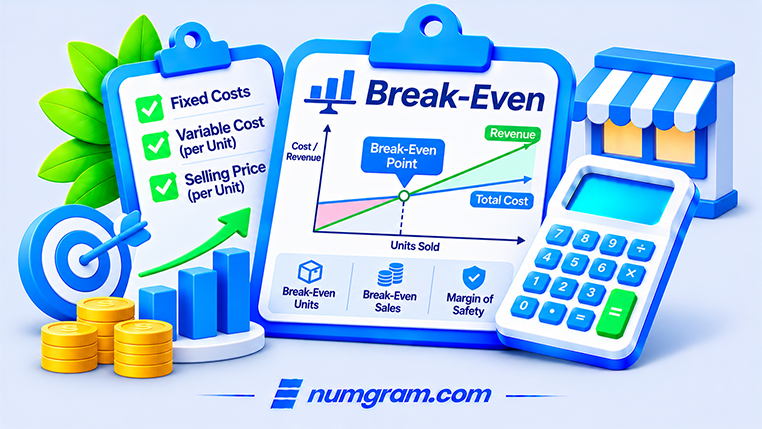
Use this break-even calculator to estimate how many units you need to sell, and how much sales revenue you need to generate, to cover your costs. Enter your fixed costs for the period, the selling price per unit, and the variable cost per unit. The calculator uses the contribution margin to find the break-even point.
The break-even point is the sales level at which total revenue equals total costs. Below that point, the business has an operating loss under the assumptions used. Above it, each additional unit sold contributes toward profit, provided the price and cost assumptions remain valid.
Information to Enter
Fixed costs are costs that generally do not change directly with the number of units sold over the period being analyzed. Examples may include rent, insurance, software subscriptions, salaried overhead, and equipment leases. Enter the total fixed costs for one clearly defined period, such as a month or year.
Selling price per unit is the amount of revenue received for each unit sold, before subtracting variable costs. Use the average realized price if you routinely offer discounts or sell at different prices.
Variable cost per unit is the cost that changes with each additional unit produced or sold. It may include materials, direct labor, packaging, transaction fees, and shipping paid by the business. Use the same unit basis as the selling price.
Break-Even Formulas
- Contribution margin per unit = selling price per unit − variable cost per unit
- Contribution margin ratio = contribution margin per unit ÷ selling price per unit × 100
- Break-even units = fixed costs ÷ contribution margin per unit
- Break-even sales revenue = break-even units × selling price per unit
Because businesses generally cannot sell a fraction of a physical unit, use the next whole unit as the practical unit target. The underlying break-even calculation may be fractional; rounding up ensures the target is not below the calculated threshold. Sales revenue is based on the unrounded break-even quantity in the standard formula, while an operational sales target can be estimated by multiplying the rounded-up unit count by the selling price.
Worked Example
Suppose a small business has $5,000 in fixed costs for the month. It sells a product for $50 per unit and spends $30 in variable costs for each unit. The contribution margin is $20 per unit. Dividing $5,000 by $20 gives a break-even point of 250 units. At $50 per unit, break-even sales revenue is $12,500.
| Measure | Calculation | Result |
|---|---|---|
| Fixed costs | Given | $5,000 |
| Selling price per unit | Given | $50 |
| Variable cost per unit | Given | $30 |
| Contribution margin per unit | $50 − $30 | $20 |
| Break-even units | $5,000 ÷ $20 | 250 |
| Break-even sales | 250 × $50 | $12,500 |
| Contribution margin ratio | $20 ÷ $50 × 100 | 40% |
Why Contribution Margin Matters
Contribution margin is the amount from each sale that remains after paying the variable cost of that unit. It is available to cover fixed costs first. Once fixed costs are covered, additional contribution margin can contribute to operating profit, assuming no other relevant costs change.
A higher contribution margin lowers the number of units needed to break even. You can increase it by raising the selling price, reducing variable cost, or changing the product mix toward items with stronger contribution margins. Each option may have trade-offs: customers may resist higher prices, suppliers may limit cost reductions, and a product mix change may affect demand.
How Fixed and Variable Costs Affect the Result
Higher fixed costs raise the break-even point because the business must generate more contribution margin before covering its overhead. Higher variable costs reduce contribution margin per unit and also raise the required sales volume. Lowering fixed costs or negotiating lower variable costs can reduce the sales target, but the impact should be assessed alongside service quality, capacity, and long-term needs.
When costs are mixed, separate the fixed and variable portions as carefully as possible. For example, a utility bill may have a fixed service charge plus a usage-based amount. Treating the entire bill as fixed or variable can distort the estimate.
Using Break-Even Analysis for Decisions
Break-even analysis can help evaluate a new product, a price change, a marketing campaign, a new location, or a planned increase in overhead. Compare the break-even sales target with realistic demand and production capacity. If the required volume is far above expected sales, revisit pricing, cost structure, or the business plan.
You can also compare scenarios. Calculate the break-even point at several prices or variable cost levels to see how sensitive the result is. When offering discounts, use the discounted average selling price and recalculate contribution margin. A lower price can require substantially more units to cover the same fixed costs.
Assumptions and Limitations
- The calculator assumes a single product or a stable average selling price and variable cost per unit.
- Fixed costs are assumed to remain constant over the period and within the relevant sales range.
- Variable cost per unit is assumed to remain constant as volume changes.
- The model does not automatically account for multiple products with different contribution margins, inventory changes, capacity constraints, step-fixed costs, taxes, financing costs, or price changes at different volumes.
- If selling price is less than or equal to variable cost, contribution margin is zero or negative and there is no finite positive break-even unit target under this simple model.
- Use costs and prices from the same period, currency, and unit definition.
- This is a planning estimate, not accounting, tax, or investment advice.
Common Break-Even Mistakes to Avoid
Do not include variable costs in fixed costs and then subtract them again per unit. Keep the periods consistent: monthly fixed costs should be compared with monthly sales assumptions. Avoid using list price if discounts, returns, or sales commissions reduce the actual revenue received. Make sure the variable cost includes all per-unit costs relevant to the analysis.
Another common mistake is assuming that reaching break-even means the business is financially healthy. The calculation does not automatically include cash flow timing, debt repayment, capital investment, owner compensation, or taxes. Review those items separately when planning business finances.
Frequently Asked Questions
What is the break-even point?
It is the sales level where total revenue equals total fixed and variable costs. At that point, the business has neither a profit nor a loss under the model’s assumptions.
How do I calculate break-even units?
Divide total fixed costs by contribution margin per unit. Contribution margin per unit is selling price minus variable cost per unit.
What happens if selling price equals variable cost?
Contribution margin is zero. Each unit sold contributes nothing toward fixed costs, so there is no finite break-even quantity under this model.
Should I round break-even units up?
Yes, for a practical target expressed in whole units. If the mathematical result is 250.2 units, the business needs to sell 251 whole units to reach or exceed the threshold.
Does break-even analysis include profit?
No. Break-even is the point at which profit is zero. To plan for a desired profit, add that target profit to fixed costs before dividing by contribution margin per unit.
Can I use this calculator for services?
Yes, if you can define a consistent service unit, such as a session, project, or billable hour, and estimate its average selling price and variable cost. For mixed service packages, use a suitable weighted average.
What if my business sells multiple products?
A single-product calculation may not represent a mixed business. You can estimate a weighted average contribution margin based on the expected sales mix, but the break-even point will change if that mix changes.
How often should I update the calculation?
Recalculate when prices, supplier costs, wages, rent, product mix, or sales assumptions change. A regular review helps keep the target aligned with current operating conditions.