How to Use the Target Heart Rate Calculator
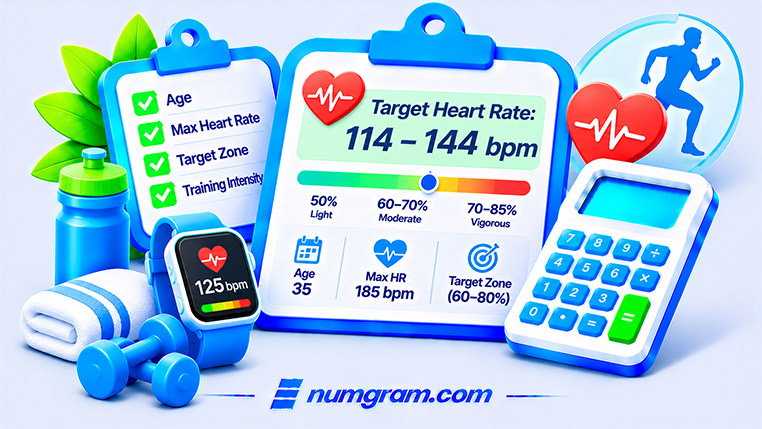
This calculator estimates a general exercise heart-rate range using age and selected intensity percentages. It estimates maximum heart rate with the simple age-based formula 220 minus age, then calculates the lower and upper limits as percentages of that estimate. Results are a general guide, not a medical assessment or individualized exercise prescription.
Information to Enter
Age: Enter completed years. This calculator is intended as a general adult reference for ages 18 through 100.
Lower intensity: Enter the lower percentage of estimated maximum heart rate. The default is 50%.
Upper intensity: Enter the upper percentage. The default is 85%. Keep the lower percentage below the upper percentage.
Target Heart Rate Formula
- Estimated maximum: 220 − age
- Lower target: estimated maximum × lower intensity ÷ 100
- Upper target: estimated maximum × upper intensity ÷ 100
Heart rate is expressed in beats per minute (bpm). Results are rounded to the nearest whole beat per minute.
Worked Example
For a 30-year-old using a 50% to 85% intensity range, estimated maximum heart rate is 220 − 30 = 190 bpm. The lower target is 190 × 0.50 = 95 bpm. The upper target is 190 × 0.85 = 161.5 bpm, or about 162 bpm. The estimated range is approximately 95–162 bpm.
Understanding Exercise Intensity
Heart-rate zones are often described as percentages of maximum heart rate. Lower intensities may feel comfortable and allow conversation; higher intensities feel more demanding. The relationship between a percentage and perceived effort differs by person, fitness level, environment, and activity.
Why the 220 Minus Age Formula Is Limited
This is a population-level rule of thumb. It can overestimate or underestimate an individual’s maximum heart rate. Age alone does not account for genetics, training history, medications, health conditions, temperature, hydration, stress, or other factors. A measured maximum heart rate or professionally assessed plan may be more appropriate for some people.
Using the Estimate Responsibly
Use the result as a broad educational reference, not a number you must reach. Pay attention to how you feel, your breathing, and symptoms. Increase intensity gradually. Stop exercising and seek appropriate medical help if you experience chest pain, faintness, unusual shortness of breath, or other concerning symptoms.
Assumptions and Limitations
- Uses the simple estimated maximum heart-rate formula 220 minus age.
- Calculates selected percentages from that estimate; it does not measure heart rate.
- Does not account for resting heart rate, medications, medical conditions, fitness, or individual physiology.
- Provides general educational information for adults, not a personalized prescription.
- Actual heart-rate response varies with activity, environment, stress, and health.
- Consult a qualified healthcare professional if you have a health condition, take medication that affects heart rate, are pregnant, or are unsure what intensity is appropriate.
Common Target Heart Rate Mistakes
Do not assume the age-based maximum is your true maximum. Do not treat a zone boundary as a requirement or push through warning symptoms to reach a number. Some medications affect heart rate and can make standard percentage zones unsuitable.
Frequently Asked Questions
What is target heart rate?
It is a heart-rate range often used as a general guide to exercise intensity, expressed in beats per minute.
How is maximum heart rate estimated?
This calculator uses 220 minus age, a simple rule of thumb that may not accurately represent an individual.
What does 50% to 85% mean?
The limits are calculated as 50% and 85% of estimated maximum heart rate.
Is this my medically recommended range?
No. It does not account for medical history, medications, or individual response.
Can medication change my target heart rate?
Yes. Ask your healthcare professional whether age-based zones are suitable for you.
Should I exercise until I reach the upper number?
No. The upper limit is not a goal you must reach. Choose an intensity appropriate to your circumstances.
Why might my watch show a different maximum?
Wearables may use different formulas or measured data, so estimates can differ.
Is this suitable for children?
No. Children and adolescents need age-appropriate guidance.