How to Use the Running Pace Calculator
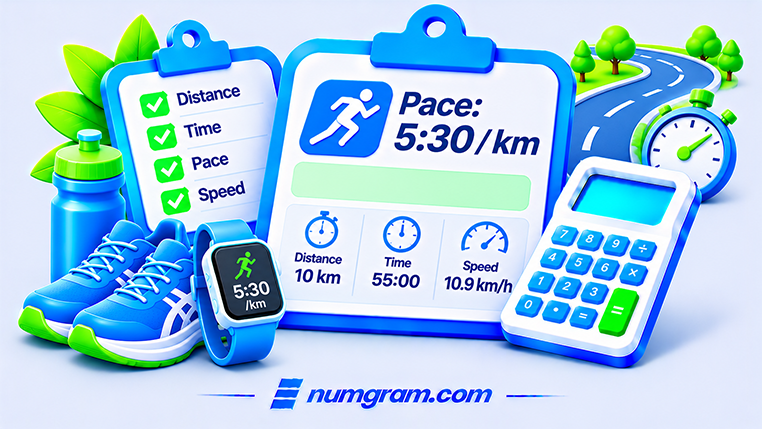
This running pace calculator works out your average pace and speed from the distance you covered and the elapsed time. It displays pace in minutes per kilometer and minutes per mile, plus average speed in kilometers per hour and miles per hour. It can be used for training runs, races, walks, and other timed distances.
Enter the distance and choose kilometers or miles. Then enter your total elapsed time as minutes. For example, enter 30 for a 30-minute run, or 95.5 for 1 hour, 35 minutes, and 30 seconds. The calculator converts the distance to a common base unit before calculating both pace formats.
Information to Enter
Distance: Enter the total distance covered. Select kilometers or miles from the unit selector. Use the distance actually completed, not a planned route distance if it differs.
Total time: Enter elapsed time in decimal minutes. Convert hours and seconds to minutes before entering them. One hour is 60 minutes, and one second is 1/60 of a minute. Include the full elapsed time if you want average pace including stops.
Running Pace Formulas
Average pace is elapsed time divided by distance:
- Pace (minutes per kilometer): Total time in minutes ÷ distance in kilometers
- Pace (minutes per mile): Total time in minutes ÷ distance in miles
- Speed (km/h): Distance in kilometers ÷ time in hours
- Speed (mph): Distance in miles ÷ time in hours
The calculator displays pace as decimal minutes per distance unit. For example, 6.5 min/km means 6 minutes and 30 seconds per kilometer. To convert the decimal portion to seconds, multiply it by 60.
Worked Example
Suppose you run 5 kilometers in 30 minutes:
| Measure | Calculation | Result |
|---|---|---|
| Distance | Given | 5 km |
| Elapsed time | Given | 30 minutes |
| Pace per kilometer | 30 ÷ 5 | 6.00 min/km (6:00) |
| Distance in miles | 5 ÷ 1.609344 | 3.1069 miles |
| Pace per mile | 30 ÷ 3.1069 | 9.66 min/mile (about 9:39) |
| Speed | 5 ÷ 0.5 hours | 10 km/h (6.21 mph) |
Understanding Pace and Speed
Pace describes how long it takes to cover a unit of distance. A lower minutes-per-kilometer or minutes-per-mile number means a faster pace. Speed describes distance covered per unit of time, so a higher km/h or mph number means faster movement. Pace and speed express the same performance in different ways.
Elapsed Time Versus Moving Time
GPS watches and running apps may report both elapsed time and moving time. Elapsed time includes stops; moving time may exclude pauses detected by the device. Use the time that matches the question you want to answer. Race results generally use official elapsed time, while some training summaries show moving pace.
Using Pace for Training
Average pace can help compare efforts across distances, but terrain, elevation, weather, surface, fatigue, and route conditions all influence performance. A single average does not show how evenly you ran or how effort changed during the session. Splits or lap data can provide more detail.
Assumptions and Limitations
- The calculator assumes the entered time is total elapsed time in decimal minutes.
- It calculates average pace and speed; it does not predict race performance or prescribe training intensity.
- It assumes the distance and time refer to the same activity.
- GPS distance and moving-time estimates can contain measurement error.
- Pace does not account for elevation, terrain, weather, stops, or effort.
- Results are mathematical estimates and are rounded for display.
Common Running Pace Calculation Mistakes
Do not enter a time in hours-and-minutes format into a decimal-minute field. For example, 1 hour 30 minutes is 90 minutes, not 1.30 minutes. Check whether your source reports kilometers or miles, and avoid mixing elapsed time with moving time when comparing runs. Remember that 6.25 min/km means 6 minutes 15 seconds per kilometer, not 6 minutes 25 seconds.
Frequently Asked Questions
What is running pace?
Running pace is the time needed to cover a unit of distance, commonly expressed as minutes per kilometer or minutes per mile.
How do I calculate pace?
Divide total elapsed time by distance. Use minutes and the same distance unit for the pace you want.
What does 6:00 min/km mean?
It means each kilometer takes 6 minutes. The equivalent is about 9 minutes 39 seconds per mile.
How do I enter 1 hour 30 minutes?
Enter 90 because the time field uses decimal minutes.
Is a lower pace faster?
Yes. A lower minutes-per-distance value means less time is needed to cover that distance.
Should I use elapsed time or moving time?
Use elapsed time for an overall time including stops, or moving time when you specifically want pace while moving. Be consistent when comparing activities.
Can I use miles instead of kilometers?
Yes. Choose miles in the distance unit selector. The calculator provides both pace formats.
Does this predict my race time?
No. It calculates average pace for a completed distance and time. Race prediction requires additional assumptions and is a separate calculation.