How to Use the Race Time Predictor
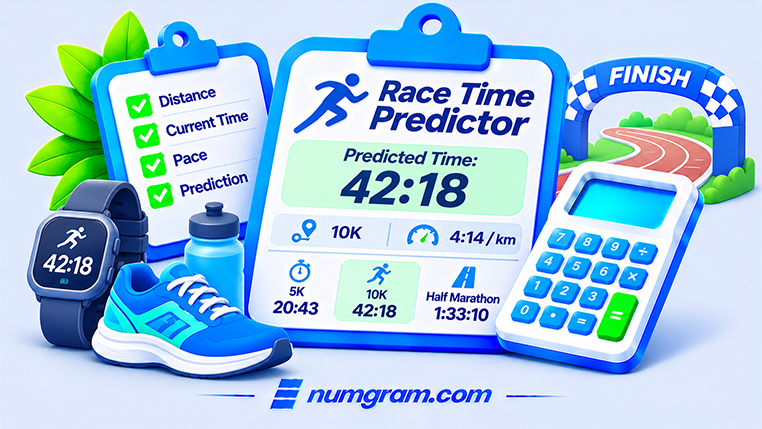
This race time predictor estimates finish times at standard running distances from a recent race result. Enter the distance you completed and your elapsed finish time. The calculator uses the Riegel prediction model to estimate equivalent performances at 5K, 10K, half-marathon, and marathon distances.
Predictions are mathematical estimates, not promises. They assume a reasonably comparable level of preparation and endurance across distances. A short race result may not predict a marathon well if you have not completed the longer training needed for that event.
Information to Enter
Recent race distance: Enter the distance of a completed, timed effort and select kilometers or miles. Use the actual measured distance where possible. The calculator converts the distance to meters before applying the prediction formula.
Finish time: Enter elapsed time in decimal minutes. For example, 25 minutes is 25, while 1 hour 45 minutes is 105. Include the full elapsed time for a result that reflects official race timing.
Race Time Prediction Formula
The calculator uses the Riegel model: T₂ = T₁ × (D₂ ÷ D₁)1.06
- T₁: Time from the recent race.
- D₁: Distance of the recent race.
- T₂: Predicted time for the target distance.
- D₂: Target race distance.
The exponent 1.06 represents an assumed relationship between distance and sustainable performance. It is a commonly used model, but individual endurance profiles vary.
Worked Example
Suppose a runner completes 5 kilometers in 25 minutes. The model predicts the following approximate times:
| Target distance | Predicted time |
|---|---|
| 5K | 25:00 |
| 10K | 52:07 |
| Half marathon | About 1:55:00 |
| Marathon | About 3:59:47 |
These values illustrate the model only. A 5K performance by itself does not demonstrate that a runner has the endurance or preparation for a half marathon or marathon.
How to Interpret Predicted Times
Use the estimates as a broad comparison or planning reference. They can help set an initial range for a goal, but they should not replace a training history, recent longer-distance performance, or realistic assessment of race conditions. Predictions become more useful when the source race is recent, accurately measured, and completed at a strong, even effort.
Why Predictions Can Be Inaccurate
The model cannot account for all differences in endurance, running economy, course elevation, weather, surface, fueling, hydration, pacing, illness, or fatigue. It also cannot tell whether a runner has completed enough weekly mileage or long runs for a longer event. Some runners maintain pace well as distance increases; others slow more than the model predicts.
Choosing a Useful Source Race
Choose a recent race or time trial with a reliable distance and timing result. An all-out effort on a flat, accurately measured course is generally more useful than an easy training run, a hilly route, or a workout interrupted by stops. Avoid using an old personal best if current fitness has changed.
Assumptions and Limitations
- The calculator applies the Riegel model with an exponent of 1.06.
- It assumes the source performance is a representative, hard effort.
- It estimates standard 5K, 10K, half-marathon (21.0975 km), and marathon (42.195 km) times.
- It does not evaluate training volume, endurance, health, weather, course profile, or race strategy.
- It may be less accurate when extrapolating from a short event to a much longer distance.
- Predictions are estimates and should not be treated as guaranteed finish times.
Common Race Prediction Mistakes
Do not treat a short-distance result as proof of marathon readiness. Check whether the input time is entered in decimal minutes, not an hours-and-minutes notation. Use a recent, measured performance and remember that a model cannot account for training gaps, illness, heat, hills, or race-day decisions.
Frequently Asked Questions
What is a race time predictor?
It estimates equivalent finish times at other distances from a recent race performance using a mathematical model.
Which formula does this calculator use?
It uses the Riegel model with an exponent of 1.06.
How should I enter 1 hour 45 minutes?
Enter 105 because the time field uses decimal minutes.
Can a 5K predict a marathon?
It can produce a mathematical estimate, but a 5K alone does not establish marathon endurance or readiness.
Are predicted times guaranteed?
No. Fitness, training, course conditions, weather, pacing, and many other factors affect actual performance.
Should I use a recent or personal-best time?
Use a recent result that reflects current fitness. An old personal best may no longer be representative.
Does the calculator account for hills or weather?
No. The model uses only distance and elapsed time.
Can I use a training run?
You can, but an accurately measured, strong, uninterrupted effort is generally a more useful input than an easy or interrupted run.