How to Use the Calorie Deficit Calculator
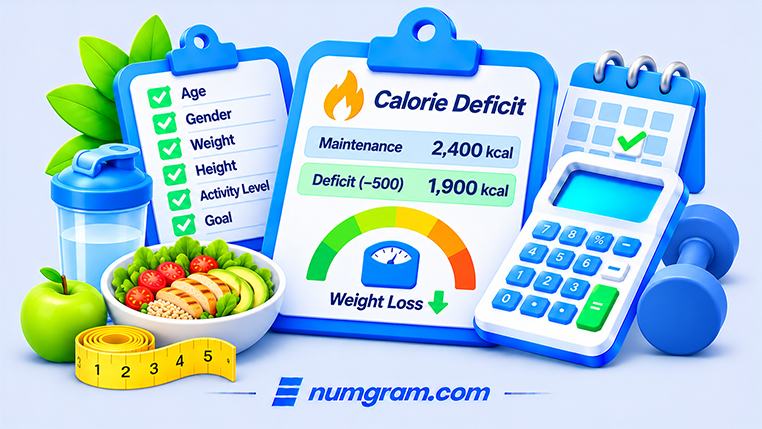
This calculator compares an estimated daily maintenance energy expenditure with a planned daily calorie intake. If intake is below estimated maintenance, the difference is a calorie deficit. If intake is above maintenance, the result is a surplus. The tool also converts the daily difference into a weekly energy estimate and a rough theoretical weight-change estimate.
Enter your estimated maintenance calories per day, then enter the daily calorie intake you want to evaluate. Maintenance calories are often estimated using a TDEE calculator or assessed with a qualified professional. The result is an educational comparison, not a recommendation for how much you should eat.
Information to Enter
Estimated maintenance calories: Enter your estimated total daily energy expenditure (TDEE) in kilocalories per day. This is the approximate energy your body uses across an average day, including activity.
Planned daily calorie intake: Enter the intake value you want to compare with maintenance. Use the same unit, kcal per day. The calculator does not determine whether that intake is adequate or appropriate for you.
Calorie Deficit Formula
The daily energy difference is calculated as:
- Daily deficit or surplus: Maintenance calories − planned intake
- Weekly energy difference: Daily difference × 7
- Approximate weekly weight change (kg): Weekly energy difference ÷ 7,700
- Approximate weekly weight change (lb): Weekly energy difference ÷ 3,500
A positive result means intake is below estimated maintenance. A negative result means intake is above estimated maintenance. The weight-change equivalents use simplified energy-density rules and are not predictions of an individual’s actual results.
Worked Example
Suppose estimated maintenance is 2,400 kcal/day and the planned intake being evaluated is 1,900 kcal/day:
| Step | Calculation | Result |
|---|---|---|
| Maintenance | Given estimate | 2,400 kcal/day |
| Planned intake | Given value | 1,900 kcal/day |
| Daily deficit | 2,400 − 1,900 | 500 kcal/day |
| Weekly difference | 500 × 7 | 3,500 kcal/week |
| Approximate weekly change | 3,500 ÷ 7,700 | 0.45 kg/week |
The same weekly energy difference is approximately equivalent to one pound using the simplified 3,500 kcal-per-pound rule. These are mathematical approximations, not guaranteed weight changes.
Deficit, Maintenance, and Surplus
A calorie deficit occurs when energy intake is lower than energy expenditure over time. Maintenance describes an approximate balance between intake and expenditure. A surplus occurs when intake is higher than expenditure. The calculator labels the arithmetic difference; it cannot determine whether a particular deficit or surplus is suitable for an individual.
Why the 3,500-Calorie Rule Is Limited
The familiar rule that 3,500 calories equals about one pound of body fat is a simplified approximation. Human bodies adapt as weight, appetite, activity, and energy expenditure change. Water balance, digestion, hormonal factors, medication, sleep, and other variables can affect scale weight. Actual changes are not perfectly linear, so a calculator should not be used to forecast an exact date or amount of weight loss.
Choosing a Maintenance Estimate
Maintenance calories are not directly measured by this calculator. They may come from a TDEE equation, a clinician or registered dietitian, or a carefully interpreted record of intake and weight trends. Each method has uncertainty. If the maintenance estimate is inaccurate, the calculated deficit or surplus will also be inaccurate.
How to Interpret the Result
Use the daily and weekly energy differences as a comparison of the two numbers you entered. Do not treat the approximate kilogram or pound equivalent as a promise. If your goal involves changing weight, consider health history, nutritional adequacy, activity, and personal circumstances. A qualified healthcare professional or registered dietitian can help assess an appropriate plan.
Assumptions and Limitations
- The calculator assumes the maintenance estimate and planned intake are expressed in kcal per day.
- It calculates arithmetic differences; it does not prescribe a calorie target or create a meal plan.
- The 7,700 kcal/kg and 3,500 kcal/lb conversions are rough theoretical approximations.
- Real-world weight change is dynamic and affected by adaptation, fluid shifts, body composition, and many individual factors.
- The calculator is not designed for children, adolescents, pregnancy, breastfeeding, eating-disorder recovery, or medical nutrition therapy.
- It is educational information, not a diagnosis or substitute for individualized medical or dietetic advice.
Common Calorie Deficit Calculation Mistakes
Do not confuse BMR with maintenance calories: maintenance generally refers to total daily energy expenditure. Enter both values in kcal per day, not kilojoules or calories per week. Avoid assuming that a larger calculated deficit is automatically better or safer. Do not interpret the theoretical weight-change estimate as a guaranteed outcome.
Frequently Asked Questions
What is a calorie deficit?
A calorie deficit means energy intake is lower than energy expenditure over a period of time.
How do I estimate maintenance calories?
A TDEE calculator can provide a starting estimate, but equations are approximate. A qualified professional can help interpret your individual needs.
Does this calculator recommend how many calories to eat?
No. It compares a planned intake with an estimate you provide. It does not decide whether that intake is appropriate or nutritionally adequate.
Is 3,500 calories always equal to one pound?
No. It is a simplified rule of thumb. Actual body-weight change is dynamic and does not follow a perfectly linear equation.
Why can actual weight change differ from the estimate?
Energy expenditure can adapt, and water balance, body composition, activity, health, and other factors influence scale weight.
Can this calculator be used for children or teens?
No. It is intended as general educational information for adults. Growing children and adolescents need age-appropriate assessment.
Is a calorie deficit appropriate for everyone?
No. Individual health, age, pregnancy, medical conditions, medications, and eating-disorder history can change what is appropriate. Seek qualified guidance when in doubt.
What does a negative deficit mean?
A negative result means the planned intake is higher than the maintenance estimate you entered, which is an estimated energy surplus.