How to Use the BMI Calculator
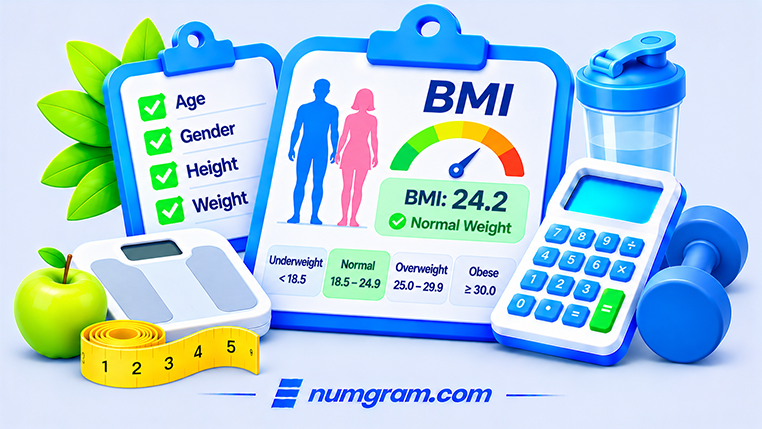
This BMI calculator estimates Body Mass Index from your height and weight. Enter both measurements using the available units, then calculate your BMI. The result can be compared with standard adult BMI categories. BMI is a screening measure, not a diagnosis, and it cannot describe your overall health on its own.
For the standard adult calculation, BMI is weight in kilograms divided by height in meters squared. The calculator converts supported height and weight units to a consistent base before applying the formula. Use a recent, reasonably accurate weight and measure your height without shoes for a more useful estimate.
Information to Enter
Weight is your body weight. Choose the unit shown beside the field and enter the value in that unit. For the most consistent result, use a scale on a firm, level surface and similar conditions when comparing measurements over time.
Height is your standing height. Select the appropriate unit and enter your height accurately. If entering a measurement in feet and inches is not offered as a combined field, convert it to one supported unit before entering it.
BMI Formula
The metric formula is:
BMI = weight (kg) ÷ height (m)²
For US customary measurements, the equivalent formula is:
BMI = 703 × weight (lb) ÷ height (in)²
The formulas produce the same BMI when the measurements are equivalent. BMI is expressed as a number, not as a percentage. Rounding may cause small differences between calculators, so the unrounded value is best for determining which side of a category threshold a result falls on.
Adult BMI Categories
| Adult BMI | Category |
|---|---|
| Below 18.5 | Underweight |
| 18.5 to less than 25 | Healthy weight |
| 25 to less than 30 | Overweight |
| 30 or higher | Obesity |
These commonly used categories apply to adults age 20 and older. BMI categories are screening ranges and should not be interpreted as a complete assessment of an individual’s health, body composition, or personal circumstances.
Worked Example
Suppose an adult weighs 70 kilograms and is 1.75 meters tall. First, square the height: 1.75 × 1.75 = 3.0625. Then divide weight by that value: 70 ÷ 3.0625 = 22.86. The estimated BMI is 22.86, which falls in the standard healthy-weight adult category.
| Step | Calculation | Result |
|---|---|---|
| Weight | Given | 70 kg |
| Height | Given | 1.75 m |
| Height squared | 1.75 × 1.75 | 3.0625 m² |
| BMI | 70 ÷ 3.0625 | 22.86 |
| Adult category | 18.5 to less than 25 | Healthy weight |
What BMI Can and Cannot Tell You
BMI is useful as a quick population-level screening measure because it uses two measurements that are relatively easy to obtain. It can help identify weight ranges that may be associated with increased health risks and can be one starting point for a conversation with a qualified healthcare professional.
BMI does not directly measure body fat, muscle mass, bone density, or where fat is distributed. A muscular athlete may have a higher BMI without having excess body fat. Conversely, a person can have a BMI in the standard range and still have health risks that BMI does not reveal. Age, pregnancy, medical history, ethnicity, and other factors can affect how a result should be interpreted.
Who Should Not Rely on Standard Adult BMI Categories?
Standard adult BMI categories are not interpreted the same way for children and teenagers. For people ages 2 through 19, BMI is assessed using age- and sex-specific growth charts and percentiles. This calculator is intended for adults and should not be used to classify a child’s weight status.
Pregnant people should not use BMI during pregnancy as a measure of current weight status. BMI also has limitations for older adults, highly muscular people, and some population groups. A clinician can help interpret measurements in context and decide whether additional assessments are appropriate.
Using BMI Over Time
If you track BMI, use measurements taken consistently and look at trends rather than reacting to small day-to-day changes. Body weight naturally fluctuates with hydration, meals, clothing, and other factors. A small change in BMI may simply reflect measurement variation.
For a broader picture, a healthcare professional may consider waist circumference, blood pressure, lab results, medical history, physical activity, nutrition, and other measures. No single number captures every aspect of health.
Assumptions and Limitations
- This calculator uses the standard adult BMI formula and adult category cutoffs.
- It assumes the entered height and weight are accurate and refer to the same person.
- BMI is a screening measure and does not directly measure body fat or diagnose a condition.
- Adult BMI categories are not intended for children and teenagers; their assessment requires age- and sex-specific growth charts.
- Pregnancy, athletic muscularity, age, body composition, and individual medical circumstances can affect interpretation.
- Results near a category boundary may be affected by measurement and rounding differences.
- This tool is educational and is not a substitute for personalized medical advice, diagnosis, or treatment.
Common BMI Calculation Mistakes
Use height squared, not height multiplied by two. Keep units consistent: the metric formula requires kilograms and meters, while the customary formula requires pounds and inches. Do not enter centimeters as though they were meters. Measure height without shoes and avoid relying on an old weight measurement if your weight has changed.
Another common mistake is treating a category label as a verdict about health. BMI is only one screening measure. If you have concerns about weight, nutrition, growth, or a health condition, discuss them with a qualified healthcare professional rather than making decisions based only on this result.
Frequently Asked Questions
What does BMI stand for?
BMI stands for Body Mass Index. It is a value calculated from a person’s weight and height and is used as a screening measure in adults.
What is a healthy adult BMI range?
The commonly used healthy-weight category for adults is BMI 18.5 to less than 25. This range is a screening classification and does not guarantee that an individual is healthy.
Is BMI the same as body fat percentage?
No. BMI uses height and weight, while body fat percentage estimates the proportion of body weight that is fat. The two measures are not interchangeable.
Can BMI be misleading for athletes?
Yes. People with greater muscle mass may have a higher BMI even when they do not have excess body fat. Additional assessment may be useful.
Can I use this BMI calculator for a child?
No. Children and teenagers need BMI-for-age percentiles based on age and sex, interpreted using appropriate growth charts. Standard adult cutoffs should not be applied to them.
How often should I calculate BMI?
There is no universal schedule. If tracking it is useful in your circumstances, use consistent measurements and focus on longer-term patterns. Ask a healthcare professional what monitoring is appropriate for you.
Does a BMI in the healthy range mean I have no health risks?
No. BMI does not measure every health factor. Other measurements, medical history, lifestyle, and clinical assessment may be important.
What should I do if my result concerns me?
Consider discussing the result with a qualified healthcare professional who can interpret it alongside your health history and other relevant measures. Avoid making major diet or exercise changes based only on an online calculator.