What Is a Fraction?
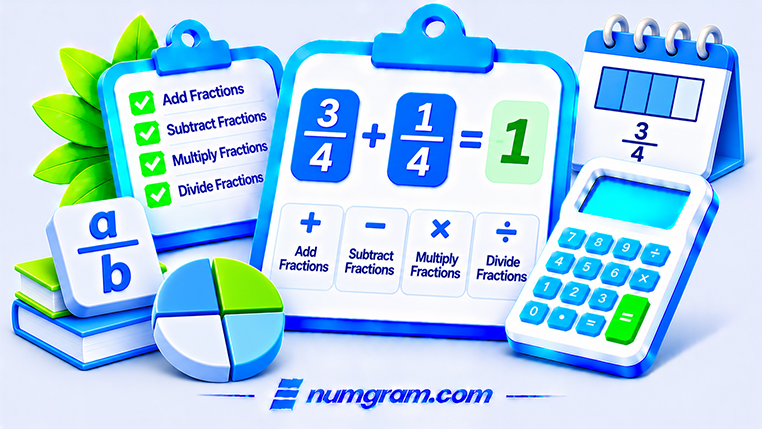
A fraction represents a part of a whole or a quantity divided into equal parts. It consists of two numbers separated by a horizontal line called a fraction bar.
Every fraction has two components:
- Numerator: The top number, which tells you how many parts are being considered.
- Denominator: The bottom number, which tells you how many equal parts make up the whole.
For example, in the fraction 3/4, the numerator is 3 and the denominator is 4. This means that three out of four equal parts are being represented.
Imagine a pizza divided into four equal slices. If you take three slices, you have 3/4 of the pizza.
Fractions are used in mathematics, cooking, construction, measurements, shopping, and many everyday situations. They help you work with quantities that are smaller or larger than whole numbers. For a deeper understanding, explore Khan Academy’s guide to fraction arithmetic.
Table of Contents
- What Is a Fraction?
- How to Use the Fraction Calculator
- Types of Fractions
- How to Add Fractions
- How to Subtract Fractions
- How to Multiply Fractions
- How to Divide Fractions
- How to Simplify Fractions
- How to Convert an Improper Fraction to a Mixed Number
- How to Convert a Fraction to a Decimal
- Understanding the Fraction Calculator Results
- Common Mistakes with Fractions
- Frequently Asked Questions
How to Use the Fraction Calculator
Numgram’s Fraction Calculator helps you add, subtract, multiply, and divide two fractions. Enter the numerator and denominator of each fraction, choose a mathematical operation, and select Calculate to get your answer.
The calculator displays the result in three formats: a simplified fraction, a mixed number when applicable, and a decimal value. You can also view a visual representation of the fraction and expand the step-by-step explanation to see how the calculator arrived at the answer.
Follow these steps to calculate fractions:
- Enter the first fraction: Type the numerator (top number) and denominator (bottom number) in the First Fraction section.
- Choose an operation: Select addition (+), subtraction (−), multiplication (×), or division (÷) from the operator dropdown.
- Enter the second fraction: Type the numerator and denominator of the second fraction.
- Calculate: Select the Calculate button to solve the problem.
- Review your answer: Check the simplified fraction, mixed number, and decimal value in the results section.
- Follow the calculation: View the fraction visualization and expand “How is this calculated?” to see the mathematical steps.
You can also copy, share, print, or download your calculation for future reference.
Types of Fractions
Fractions are classified into different types based on the relationship between their numerators and denominators.
Proper Fractions
A proper fraction has a numerator smaller than its denominator. Its value is less than one.
Examples: 1/2, 3/4, and 5/8.
Improper Fractions
An improper fraction has a numerator greater than or equal to its denominator. Its value is equal to or greater than one.
Examples: 5/4, 7/3, and 9/5.
Mixed Numbers
A mixed number combines a whole number and a proper fraction.
Examples: 1 1/4, 2 1/2, and 3 3/4.
You can convert an improper fraction into a mixed number. For example, 5/4 is equal to 1 1/4.
Equivalent Fractions
Equivalent fractions have different numerators and denominators but represent the same value.
Examples: 1/2, 2/4, 3/6, and 4/8.
These fractions are equivalent because they all represent one-half.
How to Add Fractions
Adding fractions combines two or more fractional quantities into one total. When the fractions have different denominators, you must first convert them into equivalent fractions with a common denominator.
How to Add Fractions with the Same Denominator
When two fractions have the same denominator, add their numerators and keep the denominator unchanged.
Formula:
a/b + c/b = (a + c)/b
Example: Add 2/7 and 3/7.
- Keep the common denominator: 7.
- Add the numerators: 2 + 3 = 5.
- Write the answer: 5/7.
Therefore:
2/7 + 3/7 = 5/7
How to Add Fractions with Different Denominators
When fractions have different denominators, find a common denominator before adding their numerators.
Example: Add 1/3 and 1/4.
- Find the least common denominator of 3 and 4, which is 12.
- Convert 1/3 into 4/12.
- Convert 1/4 into 3/12.
- Add the numerators: 4 + 3 = 7.
- Keep the common denominator: 12.
Therefore:
1/3 + 1/4 = 4/12 + 3/12 = 7/12
The answer is 7/12.
How to Subtract Fractions
Subtracting fractions means finding the difference between two fractional quantities. If the fractions have different denominators, convert them into equivalent fractions with a common denominator before subtracting.
How to Subtract Fractions with the Same Denominator
When two fractions have the same denominator, subtract the second numerator from the first and keep the denominator unchanged.
Formula:
a/b − c/b = (a − c)/b
Example: Subtract 2/9 from 7/9.
- Keep the denominator: 9.
- Subtract the numerators: 7 − 2 = 5.
- Write the result: 5/9.
Therefore:
7/9 − 2/9 = 5/9
How to Subtract Fractions with Different Denominators
First, convert both fractions into equivalent fractions with a common denominator. Then subtract their numerators.
Example: Subtract 1/2 from 3/4.
- Find a common denominator: 4.
- Convert 1/2 into 2/4.
- Subtract the numerators: 3 − 2 = 1.
- Keep the common denominator: 4.
Therefore:
3/4 − 1/2 = 3/4 − 2/4 = 1/4
The answer is 1/4.
How to Multiply Fractions
Multiplying fractions does not require a common denominator. Multiply the numerators together to get the new numerator, then multiply the denominators together to get the new denominator.
Formula:
a/b × c/d = (a × c)/(b × d)
Example: Multiply 2/3 by 3/5.
- Multiply the numerators: 2 × 3 = 6.
- Multiply the denominators: 3 × 5 = 15.
- Write the result: 6/15.
- Simplify by dividing both numbers by 3.
Therefore:
2/3 × 3/5 = 6/15 = 2/5
The simplified answer is 2/5.
Remember that you can multiply fractions directly, even when their denominators are different. Simplify the result whenever possible.
How to Divide Fractions
To divide one fraction by another, multiply the first fraction by the reciprocal of the second fraction.
A reciprocal is obtained by switching the numerator and denominator of a fraction.
This method is commonly remembered as Keep, Change, Flip:
- Keep the first fraction unchanged.
- Change the division sign (÷) to multiplication (×).
- Flip the second fraction to get its reciprocal.
Formula:
a/b ÷ c/d = a/b × d/c = (a × d)/(b × c)
Example: Divide 3/4 by 2/5.
- Keep the first fraction: 3/4.
- Change division to multiplication.
- Flip the second fraction: 2/5 becomes 5/2.
- Multiply the numerators: 3 × 5 = 15.
- Multiply the denominators: 4 × 2 = 8.
Therefore:
3/4 ÷ 2/5 = 3/4 × 5/2 = 15/8
The answer is 15/8, which is also equal to the mixed number 1 7/8.
You cannot divide by a fraction whose value is zero because division by zero is undefined.
How to Simplify Fractions
Simplifying a fraction means reducing it to its lowest terms without changing its value.
A fraction is in its simplest form when its numerator and denominator have no common factor greater than 1.
To simplify a fraction, find the greatest common divisor (GCD) of its numerator and denominator. Divide both numbers by the GCD.
Example: Simplify 12/18.
- Find the greatest common divisor of 12 and 18: GCD = 6.
- Divide the numerator by 6: 12 ÷ 6 = 2.
- Divide the denominator by 6: 18 ÷ 6 = 3.
Therefore:
12/18 = 2/3
The simplified fraction is 2/3.
Simplifying fractions makes them easier to read and compare while preserving their original values.
How to Convert an Improper Fraction to a Mixed Number
An improper fraction has a numerator greater than or equal to its denominator. You can convert it into a mixed number by dividing the numerator by the denominator.
The quotient becomes the whole-number part, the remainder becomes the new numerator, and the original denominator stays the same.
Example: Convert 17/4 into a mixed number.
- Divide the numerator by the denominator: 17 ÷ 4 = 4 remainder 1.
- Use 4 as the whole number.
- Use 1 as the new numerator.
- Keep 4 as the denominator.
Therefore:
17/4 = 4 1/4
You can also convert a mixed number back into an improper fraction. Multiply the whole number by the denominator and add the numerator. Place the result over the original denominator.
For example:
2 3/4 = (2 × 4 + 3)/4 = 11/4
How to Convert a Fraction to a Decimal
To convert a fraction into a decimal, divide the numerator by the denominator.
Formula:
Decimal value = Numerator ÷ Denominator
Example: Convert 3/8 into a decimal.
3 ÷ 8 = 0.375
Therefore, 3/8 = 0.375.
Some fractions produce terminating decimals, while others produce repeating decimals.
For example:
- 1/2 = 0.5
- 1/4 = 0.25
- 3/8 = 0.375
- 1/3 = 0.333…
A repeating decimal continues indefinitely. When a fraction calculator displays a rounded decimal, the exact fraction remains the more precise representation of the value.
Learn more about mathematics education and teaching resources from the National Council of Teachers of Mathematics (NCTM).
Understanding the Fraction Calculator Results
Numgram displays your calculated answer in three formats, helping you understand the result and use it in different situations.
Simplified Fraction
The simplified fraction shows the exact result in its lowest terms.
For example:
10/8 = 5/4
The numerator and denominator are divided by their greatest common divisor, which is 2.
Mixed Number
When the result is an improper fraction, you can also express it as a whole number and a remaining fraction.
For example:
5/4 = 1 1/4
This format is often easier to understand when working with measurements, quantities, and portions greater than one whole.
Decimal Value
The decimal value represents the same fraction using a decimal number.
For example:
5/4 = 1.25
Numgram displays decimal results rounded to up to four decimal places. Some fractions produce repeating decimals, so their displayed decimal values may be rounded approximations.
Fraction Pie-Chart Visualization
The pie-chart visualization helps you understand the simplified fraction visually.
Each circle represents one whole divided into equal sections. The denominator determines the number of sections, while the numerator determines how many sections are shaded.
For example, 3/4 represents three shaded sections out of four equal sections.
For an improper fraction such as 5/4, the visualization shows one complete whole and one-quarter of another whole.
This representation helps you see how a fraction relates to a complete quantity.
Step-by-Step Calculation
The expandable “How is this calculated?” section explains how our fraction calculator arrives at your answer.
Depending on the selected operation, the explanation shows how the calculator finds a common denominator, combines numerators and denominators, uses the reciprocal for division, and simplifies the final fraction.
You can follow these steps to check your working, identify mistakes, and understand the mathematical method behind the result.
Common Mistakes with Fractions
Understanding common fraction mistakes can help you solve problems more accurately.
1. Adding denominators
A common mistake is adding both the numerators and denominators when adding fractions.
Incorrect: 1/2 + 1/3 = 2/5
Correct: 1/2 + 1/3 = 3/6 + 2/6 = 5/6
Always find a common denominator before adding fractions with different denominators.
2. Forgetting to simplify the answer
A result such as 6/8 is mathematically correct, but it can be simplified to 3/4.
Check whether the numerator and denominator share a common factor greater than 1.
3. Flipping the wrong fraction when dividing
When dividing fractions, only the second fraction is inverted. Keep the first fraction unchanged.
For example:
3/4 ÷ 2/5 = 3/4 × 5/2
4. Finding a common denominator for multiplication
Multiplication does not require a common denominator. Multiply the numerators together and the denominators together.
5. Using zero as a denominator
A fraction with a denominator of zero is undefined. Always check that neither denominator is zero before calculating.
Explore Math Is Fun’s guide to fractions to learn about fraction concepts, types, and calculations.
Frequently Asked Questions
How Do I Add Fractions with Different Denominators?
Find the least common denominator (LCD), convert both fractions into equivalent fractions with that denominator, and add their numerators. For example, 1/3 + 1/4 becomes 4/12 + 3/12 = 7/12.
How Do I Subtract Fractions?
Find a common denominator if necessary, subtract the second numerator from the first, and keep the common denominator. Simplify the result whenever possible.
How Do I Multiply Fractions?
Multiply the numerators together and the denominators together. For example, 2/3 × 3/5 = 6/15 = 2/5.
How Do I Divide Fractions?
Keep the first fraction, change division to multiplication, and flip the second fraction. Multiply the resulting fractions and simplify the answer.
What Is the Difference Between a Proper and an Improper Fraction?
A proper fraction has a numerator smaller than its denominator, such as 3/4. An improper fraction has a numerator greater than or equal to its denominator, such as 5/4.
How Do I Convert an Improper Fraction into a Mixed Number?
Divide the numerator by the denominator. The quotient becomes the whole number, the remainder becomes the new numerator, and the original denominator stays the same. For example, 7/4 = 1 3/4.
How Do I Convert a Mixed Number into an Improper Fraction?
Multiply the whole number by the denominator, add the numerator, and place the result over the original denominator. For example, 2 1/3 = (2 × 3 + 1)/3 = 7/3.
How Do I Simplify a Fraction?
Find the greatest common divisor (GCD) of the numerator and denominator, then divide both numbers by that value. For example, 12/18 simplifies to 2/3.
Can a Fraction Be Greater Than One?
Yes. An improper fraction can have a value greater than or equal to one. For example, 5/4 is greater than one and is equal to the mixed number 1 1/4.
Why Can’T a Denominator Be Zero?
A fraction represents division of its numerator by its denominator. Division by zero is undefined, so a fraction cannot have a denominator of zero.
Is a Decimal Answer Always Exact?
No. Some fractions produce terminating decimals, while others produce repeating decimals. Numgram displays decimal results rounded to up to four decimal places. The simplified fraction represents the exact fractional result.
What Is the Difference Between a Fraction and a Decimal?
A fraction represents a value as a numerator divided by a denominator, while a decimal represents the same value using digits after a decimal point. For example, 1/4 and 0.25 represent the same quantity.
When Should I Use a Fraction Instead of a Decimal?
Fractions are useful when working with exact portions, measurements, recipes, and mathematical expressions. Decimals are often convenient for calculations involving money, measurements, and numerical comparisons. Choose the format that makes the quantity easiest to understand and use.
Can I Use the Fraction Calculator for Homework?
Yes. You can use Numgram’s Fraction Calculator to check addition, subtraction, multiplication, and division problems. The step-by-step explanation helps you review your working and understand how the calculator obtained the answer. Use it to check your own solutions and practise the methods.
Explore more free tools in Numgram’s Basic Math Calculators collection.